
Every founder is a designer for a while. You prompt an AI image generator for a logo at midnight, ask an AI assistant like Claude for a tagline, and drop both into a template for the landing page that has to go live tomorrow. That’s DIY branding, and early on it can be the right call.
The trouble is that nobody tells you when it stops being the right call. No alert pops up when your homemade logo starts costing you meetings, or when your deck, website, and product begin to look like three different companies. DIY branding doesn’t fail loudly. It just falls behind the business you’re building.
So here’s our attempt at an honest framework. We’re a creative agency, and yes, we’d love to work with you eventually. But we’d rather you hire us at the right moment than the wrong one. This is where we’d draw the line between DIY tools and a professional creative partner.
When DIY Branding Can Be the Smart Move
Early on, you’re not building a brand yet. You’re testing whether anyone cares. Spend serious money on identity before you know who your customer is, and you’ll lock in decisions you outgrow in six months. The strategic questions are still worth answering before launch, as we covered in Your Brand Before Your Product.
DIY makes sense when:
- You’re still validating the idea. If the product might pivot next quarter, so will the brand. A clean, simple placeholder buys you time without pretending to be permanent.
- Your first users already know you. People you met at a demo day or through a warm intro are buying you, not your color palette.
- Speed matters more than polish. A landing page that ships today and collects waitlist signups beats a beautiful one that launches in a month.
- The asset is internal or short-lived. A one-off event graphic, a social post, a quick explainer for your team. This is what templates and AI tools are for.
The key word is placeholder. Good DIY branding knows it’s temporary and doesn’t try to be anything more.

Signs It’s Time to Stop
There’s rarely a specific date. You cross the line when a weak first impression starts costing more than getting it right would.
You’re about to raise.
Investors pattern-match fast, and a deck that looks improvised invites questions about what else is improvised. If a priced round is on the calendar, your identity should be working for you in that room. (We dug into this in The Hidden Cost of a Bad Logo.)
You’re selling to strangers.
Once your pipeline moves past warm intros, your brand is the first thing a stranger uses to judge whether you’re credible. In B2B it can count twice, because your buyer may be defending the choice to their boss.
Your assets don’t match anymore.
The logo on the website isn’t quite the one in the app. The deck uses a different blue. When consistency depends on one founder’s memory, it’s already breaking.
You’re spending hours you don’t have.
A day a week lost to tweaking templates and rerolling AI prompts is expensive design. It just never shows up as an invoice.
You can’t say what makes you different.
If your brand could belong to any of your three closest competitors, no template or prompt will fix it. That’s a strategy problem, and it’s the one DIY tools are worst at.
The Framework: What to DIY and What to Hand Off
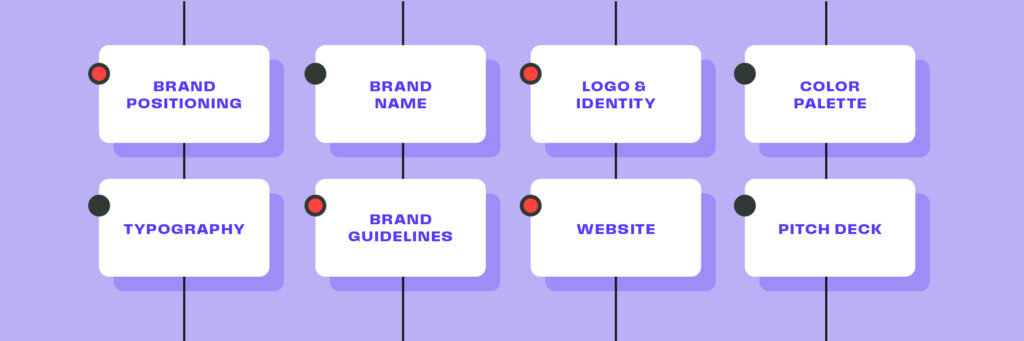
Different parts of your brand cross the line at different times. Strategy should go to a professional sooner. Execution can stay in-house much longer, once there’s a system to execute against.
Hand These Off Sooner: The Foundation
- Positioning and messaging. DIY a one-line value prop and test it. Bring in a partner once you’re pitching investors, or when you can’t say why you’re different.
- Name. Check domains and trademarks yourself. Bring in a partner when the name has to last through new products and markets.
- Logo and visual identity. A clean wordmark in one typeface and one color will carry you for a while. Bring in a partner when you’re raising, launching publicly, or selling to strangers.
- Color and typography. Pick two colors and one font, then stick to them. Bring in a partner when your assets have drifted and nobody agrees on the “real” blue.
- Brand guidelines. A one-page doc with your logo, colors, and fonts is enough to start. Bring in a partner when you’re hiring a team that will make things without you.
Keep These In-House Longer: The Production
- Website. A template landing page with a waitlist works while you validate. Bring in a partner when the site has to convert, rank, and explain a complex product.
- Pitch deck. A simple template with clear content gets you through early conversations. Bring in a partner when a priced round or strategic partnership is on the table.
- Social graphics and one-offs. Templates and AI tools are fine for everyday posts. Bring in a partner to build the templates themselves, and to check in periodically so your feed doesn’t drift toward the look every other AI-assisted brand has.
The first group is strategy. The second is production. Templates and AI tools are a reasonable place to start on both, but they only go so far. AI pulls from the same visual defaults everyone else is prompting: the same gradients, the same glossy 3D illustrations, the same tidy-but-forgettable layouts. Use it long enough, and your brand starts to look like the tool that made it.
For most growing startups, the best path is to start with templates and AI tools, then bring in a partner to audit what you’ve built. A good partner will assess what’s working, cut what isn’t, and create the custom elements that set you apart: a distinctive mark, an illustration or photo style, a type system that doesn’t read as a default. Your team can keep producing everyday assets from there, on a foundation that’s actually yours.

How to DIY Well in the Meantime
Not ready for a partner yet? You can still make the eventual handoff easier.
- Do less, consistently. One typeface, two colors, one logo lockup. Restraint reads as intentional; five fonts look like five different people built your site.
- Treat AI output as a first draft. Image generators are good for exploring directions. As final logos, generated marks are hard to trademark, rarely come as clean vector files, and usually look like everyone else’s. (More on that in AI Design Shortcuts Erode Credibility.)
- Keep your files in one place. Save the logo as a vector, write down your hex codes, and keep it all in one shared folder.
- Write down what you’re learning. Who’s buying, why they chose you, the words they use for the problem. That’s the raw material a brand strategy is built from, and no AI tool can collect it for you.
- Don’t get attached. If your placeholder brand got you to the next stage, it did its job.
The founders who get the most from a creative partner show up with clarity about their customer and market, even if their visuals are rough. That clarity is worth more than a polished logo you made yourself, and it’s the heart of a strong visual brief.
Knowing When to Stop is the Skill
Sticking with DIY branding too long costs you in places that are hard to trace: a shorter investor meeting, a candidate who went elsewhere, a buyer who wanted to wait and see. The goal isn’t to spend more on your brand. It’s to spend at the right moment, on the right things, so the brand keeps pace with the product.
Not sure which side of the line you’re on? Let’s talk it through.