

To many teams, “minimal” sounds like “simple.” Fewer elements, fewer colors, less detail, and less effort. But when it comes to logos, in reality, minimal logo design demands more precision, more strategy, and more discipline than a typical complex design.
For startups building a new brand and mid-sized organizations considering a refresh, this distinction matters. A minimal logo doesn’t give you anywhere to hide. Every line, curve, proportion, and spacing decision becomes amplified. When it works, it’s powerful. When it doesn’t, it’s painfully obvious.
Here’s why minimal logo design requires greater rigor, and why it may be the right strategic move for your brand.
Why Companies Choose Simple Logos Over Complex Ones
1. Scalability Across Modern Channels
Your logo doesn’t only live on a billboard anymore. It needs to function across:
- Website headers
- Mobile navigation bars
- Social profile avatars
- App icons
- Favicon thumbnails
- Digital ads
- Presentation decks
- Product packaging
- Event signage
A complex logo with fine details, gradients, and intricate illustrations can break down a bit at smaller sizes. Details and type may blur, and shapes can collapse into noise. Minimal logos are designed with reduction in mind and definitely hold up at 16 pixels and 16 feet. Examples:
- Apple: A single, recognizable silhouette.
- Nike: A simple swoosh that works in monochrome or full color.
- Airbnb: A refined symbol that scales effortlessly across digital touchpoints.
Each of these brands could afford complexity, but they chose restraint because scalability wins in a digital-first environment.
2. Stronger Brand Recall
Complex logos ask the viewer to process multiple elements: typography, icons, gradients, shadows, and symbolism. When you remove those excess details, you sharpen recognition. The brain remembers bold shapes faster than intricate compositions. A clean, focused mark improves your odds of being remembered after a single exposure.
If you’re considering a branding refresh, simplification often reflects brand maturity. As recognition grows, logos tend to evolve toward clarity and reduction. Think about:
- Mastercard removing overlapping color gradients
- Google refining its typography
- Instagram flattening its icon
You may think these were aesthetic trends, but more likely, they were strategic clarity decisions.

The Hard Part: Creating Visual Interest with Less
In minimal design, we’re not looking to strip personality away but instead, express it with discipline. And that’s where precision becomes critical.
When you remove decorative elements, you’re left with fundamentals:
- Proportion
- Geometry
- Negative space
- Typographic nuance
- Optical balance
- Micro-adjustments in spacing
A one-degree curve shift can change perception, a slightly off kerning pair can undermine credibility, and a poorly weighted symbol can feel amateur instantly. Every decision must earn its place, and this is why minimal logos often require more rounds of refinement, not fewer.
Strategic Reasons to Simplify
For marketing leaders, making the operational and strategic decision to simplify goes beyond aesthetics.
1. Brand Flexibility
Minimal logos adapt more easily to:
- New product lines
- Sub-brands
- Co-branded partnerships
- Motion design systems
- Global markets
2. Digital-First Performance
In social feeds and search results, attention spans are compressed. Minimal logos:
- Load cleanly in small formats
- Translate well to dark mode and light mode
- Animate effectively
- Work in monochrome environments
3. Longevity
Trendy details tend to date quickly, but minimal logos age more gracefully because they rely on form instead of decoration.
For startups building long-term brands and for mid-sized companies looking to modernize without overhauling everything, minimalism provides future-proofing.

The Hidden Risks of Minimal Logo Design
Minimal does not automatically mean better. In fact, minimal design introduces unique risks.
1. Over-Simplification
If you strip too much away, you’ll lose distinctiveness. If your mark becomes “another geometric sans-serif wordmark,” you risk your differentiation disappearing. Using precision means knowing what to remove and what to keep.
2. Generic Symbolism
Without strong conceptual grounding, circles, arrows, abstract monograms, thin-line icons, and minimal symbols can feel interchangeable. To have a successful minimal logo, you need to begin with brand strategy.
3. Weak Typography
In many minimal identities, typography is the logo. If the type selection or customization lacks intention, the entire brand feels underdeveloped.
Custom type refinements like subtle ligatures, unique letterforms, and balanced spacing are often what separate a forgettable logo from a refined one.
4. Poor Execution at Scale
Minimal logos require a robust system behind them:
- Clear spacing rules
- Defined color specifications
- Responsive logo variations
- Guidelines for icon-only vs. wordmark use
Simplicity can lead to inconsistency without the proper system.
When a Complex Logo May Make Sense
There are cases where complexity is appropriate:
- Heritage brands with deep historical roots
- Institutions relying on tradition and formality
- Luxury categories where detail signals craftsmanship
Even then, many of these brands are simplifying their marks for digital environments while preserving heritage versions for formal applications. The question isn’t “simple or complex?” It’s “what best supports your strategy and growth?”
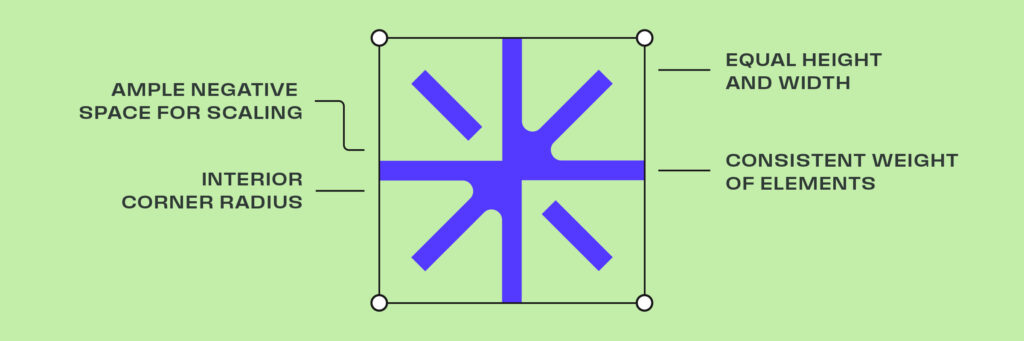
Precision in minimal logo design involves:
- Deep brand positioning before visual exploration
- Iterative refinement, not first-draft reduction
- Testing across real-world applications
- Balancing memorability with clarity
- Ensuring distinctiveness without ornamentation
For startups, this means building a foundation that scales. For mid-sized companies, it means evolving toward clarity without losing equity. Minimal design is less about “doing less” and more about doing only what matters, and executing it flawlessly.
The cleaner the logo, the more deliberate every decision must be. And in a world of crowded feeds, shrinking attention spans, and expanding digital formats, that discipline is often what separates strong brands from forgettable ones.
If you’re building a new brand or considering a refresh, we’d be happy to help you evaluate whether simplification is the right move. Contact us at The Grove Creative to start the conversation.