

Good seasonal campaign branding makes your brand look dressed for the occasion, not like a different company showed up. Holiday pushes, back-to-school drops, summer launches and year-end promos give you a reason to show up fresh. They also tempt teams to start from a blank page every time.
That’s where brands fragment. One quarter it’s a moody serif and a new palette; the next it’s a playful script and a mascot. Each campaign looks fine on its own, but together, they look like four different companies.
The fix isn’t to avoid seasonal work. It’s to decide which parts of your identity are fixed and which are allowed to flex.
Where Seasonal Campaign Branding Goes Wrong
Most brand drift doesn’t come from one bad decision. It comes from a string of reasonable ones made under deadline. A few patterns show up again and again:
- Every campaign gets its own look. A new agency, freelancer, or in-house designer reinterprets the brand from scratch because no one communicated or set up the guardrails.
- The theme overpowers the logo. Snowflakes, pumpkins, and confetti take over the layout until your mark is a footnote.
- Typography wanders. A “festive” display font sneaks in and quietly becomes the headline face for months.
- Voice shifts with the calendar. Your tone goes from confident and clear to pun-heavy and breathless, then back again.
- Campaign assets outlive the campaign. Holiday social templates and landing pages linger well into spring.
The cost is recognition. When people can’t tell a post or a package is yours at a glance, you’re paying for attention that doesn’t accrue to the brand.

Decide What’s Fixed and What Flexes
Strong brands treat their identity like a house: the foundation and frame don’t move, but you can change the paint, the lighting, and what’s on the table. Sort every element of your system into one of two buckets.
Fixed elements are what make you recognizable. They appear in every campaign, unchanged.
- Logo and wordmark: Avoid redrawing logos, and restrict seasonal lockups strictly to pre-approved variations.
- Primary typefaces: Weights and sizes can shift, but stay away from new headline faces.
- Core color palette: Add one or two seasonal accents alongside the core colors, but never in place of them.
- Brand voice: While tone may adapt or become more playful, the core vocabulary and perspective remain constant.
- Layout grid: Keep the same structure, so campaigns sit next to evergreen work without clashing.
Flexible elements are where the season lives. They can shift in intensity, color, or content, but only within limits you’ve set in advance.
- Photography and illustration: New subjects, props, and settings, shot or drawn in your established style.
- Graphic motifs and textures: Seasonal patterns live here, as supporting elements.
- Campaign messaging: Headlines and offers change, but the promise behind them doesn’t.
A useful test: cover the logo on a campaign asset. If someone who knows your brand can still tell it’s yours, the fixed elements are doing their job.

Build a Seasonal Toolkit Inside Your System
Once you know what can flex, give it a home. A seasonal toolkit is a small extension of your brand guidelines that designers pull from, instead of improvising each time.
- A seasonal accent palette: Pick one or two accent colors per season that harmonize with your core palette. Specify how much of a layout they can cover, so the core colors still lead.
- A motif library: Patterns, textures, or icon sets built on your existing shapes and line weights. If your logo uses rounded geometry, your snowflakes should too.
- Campaign templates: Social, email, web banner, and packaging templates on your standard grid, with clearly marked zones for seasonal content.
- Voice notes per season: A short paragraph on how your tone adapts, plus a few example headlines and a list of clichés to skip.
- A sunset date: Every seasonal asset gets an end date, so campaign creative doesn’t linger past its moment.
The payoff compounds. When a toolkit carries over year to year, your seasonal campaigns become recognizable traditions instead of one-off experiments. Customers start to anticipate them.
Place Each Campaign in Your Brand Architecture
Not every seasonal moment deserves the same treatment. Before kickoff, decide how far a campaign is allowed to step away from the master brand. Most fall into one of three levels.
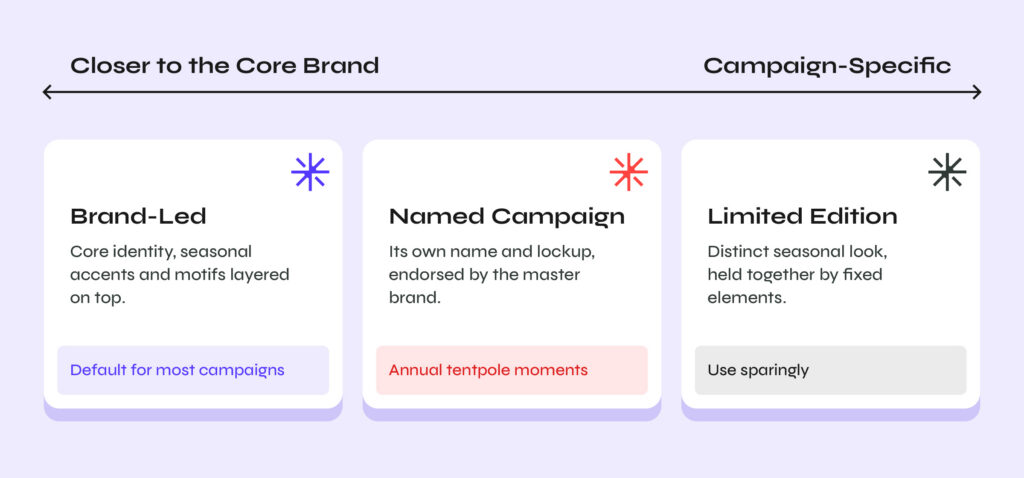
Brand-led is the right default. Your identity stays front and center, and the season shows up through accents, imagery, and messaging. Most promos, product drops, and holiday posts belong here.
Named campaigns earn their own name and lockup, but always appear with the master brand as the clear endorser. Reserve this for annual tentpoles you plan to repeat, where a recognizable campaign name builds equity over time.
Limited editions get the most visual freedom: special packaging, a collab, a one-time collector drop. They work only when your fixed elements are strong enough to anchor them. Use them rarely, or they stop feeling special.
The mistake is letting campaigns drift right on the spectrum by accident. Choose the level on purpose, write it into the brief, and then design to it.
Govern it with a Pre-Launch Check
Guidelines only work if someone checks against them. For a growing team, that doesn’t need to be a committee. Name one brand owner who reviews seasonal work before it ships, and give them a short checklist:
- Is the logo used as specified, with no seasonal redraw that wasn’t pre-approved?
- Are the core typefaces and grid intact?
- Do core colors still lead, with seasonal accents in a supporting role?
- Do the motifs and imagery come from the seasonal toolkit, or match its style?
- Does the copy sound like us, just in a seasonal mood?
- Is the campaign at the architecture level the brief called for?
- Is there a sunset date for every asset?
- Cover the logo: is it still recognizably ours?
After each season, run a quick retro. Lay the campaign next to your evergreen work and last year’s version. Keep what worked in the toolkit, cut what didn’t, and you’ll start next season ahead.
Fresh Every Season, Unmistakably You
The brands that win seasonal moments aren’t the ones that reinvent themselves four times a year. They’re the ones with a system strong enough to flex. Lock down what makes you recognizable, give the season a defined place to play, and every campaign adds to your brand instead of borrowing against it.
If your guidelines don’t yet spell out what can flex, or your last few campaigns look like they came from different companies, we can help. The Grove builds brand systems and seasonal toolkits that keep campaigns timely and on-brand. Let’s talk.